
2012 Bruce 22 Classic Electric Launch
Boat Reviews
Reviewed by Richard Crowder

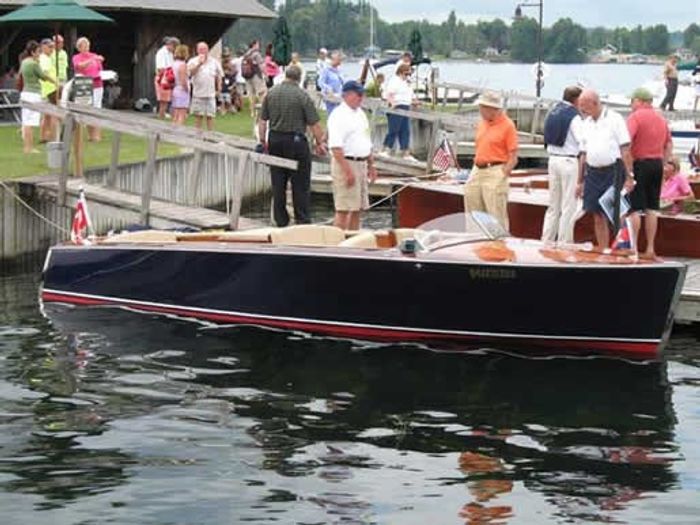
Silence is golden! As you step aboard the brand new Bruce 22 Classic Electric Launch, turn the key and slip away from the dock, practically the only sounds you hear will be the water lapping on the hull.
If you are on a non-fossil fuel waterway or against gasoline engines for whatever reasons, then this boat just may be your answer. Designer and builder, Ian Bruce, visiting friends on a small lake in eastern Ontario north of Ottawa discovered that his friends were unable to enjoy many of the power boating activities so popular on most other lakes in Canada simply because there was no gasoline available on the lake and most available electric-powered boats were too slow.
Ian later determined that some twenty-five to thirty lakes in Quebec restrict the use of fossil fuel powered boats and that the same restriction applies to most inland waters of both Austria and Switzerland among other locations, including some bodies of water in other parts of Canada and the United States. Ian correctly surmised that with today's electric propulsion technology advancing exponentially for the automobile industry, that some of this could be transplanted to the marine sector creating an electric-powered boat that could fulfill most normal power boating requirements.
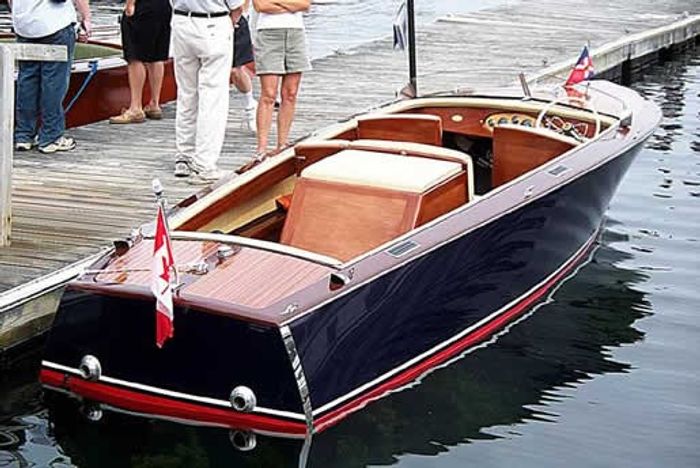
Now Ian and his Montreal Classic Boatworks already had an excellent platform from which to start experimenting in its own Bruce 22 Classic Open Utility Launch which had been perfected and on the market for a few years. That model offers separate driver's and passenger seats up front, then a full-width bench seat, behind which is the inboard motor box, and then another full-width bench seat at the rear of the cockpit ahead of the transom. Due to the physical size of the battery packs and control unit required for the electric version of the boat, the rearmost cockpit bench seat and the motorbox were removed and a solid hatch installed at deck level. The result is even more visually stunning and perhaps even more reminiscent of the classic "woodies" of old, even though this is a very modern fibreglass boat.
Through its subsidiary, TM4 Inc. of Boucherville, the giant electricity supplier Hydro Quebec had developed motors, generators, and inverters for the transportation and power generation industries. LTS Marine of Montreal had experimented with twin TM4 electric motors in a professional waterski boat with good results. Ian turned to LTS to provide a single TM4 electric motor producing 170 Newton Metres (125 pounds-feet) of peak torque and peak power output of 80 kW (108 hp).
After months of experimentation, the final layout has this single electric motor encased in aluminum and mounted on an aluminum framework amidship where the original gasoline engine was mounted with direct drive to the propeller shaft. Directly aft of the motor at the stern is the electronic control unit and inverter. Two lithium ion battery packs, each pack approximately 4-feet long by 2-feet high by 1-foot wide containing six modules with total output of 40 kWh are ingeniously mounted on fore and aft rails along the topsides next to the motor and controller.
The ingenious part is that each battery pack actually sits on ball bearings on these rails allowing the packs to be moved fore and aft a total of two feet through a chain drive actuated by servo motors. Moving the batteries rearward creates an excellent wakeboard wake and moving then forward creates better balance for cruising or waterskiing. Voilà, an electric-powered runabout for both cruising and watersports fun.
How does it all work? Considerable testing showed an excellent hole-shot onto plane given the electric motor's instantaneous torque from zero RPM and a top speed of 30 mph, fast enough for most water skiing and wakeboard enthusiasts and certainly fast enough for normal cruising activities. Fully charged batteries give the Bruce 22 a range of about 90 km (about 4-hours) at 10 mph and close to 40 km (about ½ hour) at full speed of 30 mph. Cruising at about 20 mph provides a range of about 50 km and more than one hour of cruising. Of course idling speeds will allow you a range of around 150 km on a full charge.
The 50 amp, 240 volt charger supplied will recharge the batteries 90% in about 3-hours. A pigtail to allow you to plug the charger into a standard 120-volt electric outlet will take about 16-hours to do the same job.
Interestingly enough, the Bruce 22 Classic Electric Launch weighs about 250 pounds less than its gasoline powered counterpart. Thus handling characteristics are apparently remarkably similar. LTS Marine supplies a very modern electronic "brain" readout which, along with a Garmin GPS screen, together replace the standard gauges on the dash and provide all the information the driver is likely to need.
The export market is expected to provide the greatest sales potential for the Bruce 22 Classic Electric Launch proving once again the ingenuity of Canadian entrepreneurs like Ian Bruce and his team at Montreal Classic Boatworks. But this breakthrough in electric propulsion resulting in a boat which can provide similar on-water characteristics to a gasoline powered runabout may just be what you have been waiting for. And if you like the look of the boat with the extended hatch over the aft compartment, it is also available with standard inboard MerCruiser gasoline power.
2012 Bruce 22 Classic Electric Launch Photo Gallery
| Length: | 22' 0" | 6.7 m |
| Beam: | 6' 6" | 1.98 m |
| Draft: | 1' 7" | 48.3 cm |
| Deadrise: | 20 Degrees | |
| Dry weight: | 2150 lbs | 975 kg |
| Fuel Capacity: | 40 kW / 24 kWh | |
| Engine / Drive: | TM4 |


 RVs for Sale
 Motorcycles for Sale
 Outboards for Sale
 ATVs for Sale
 Sleds for Sale


